
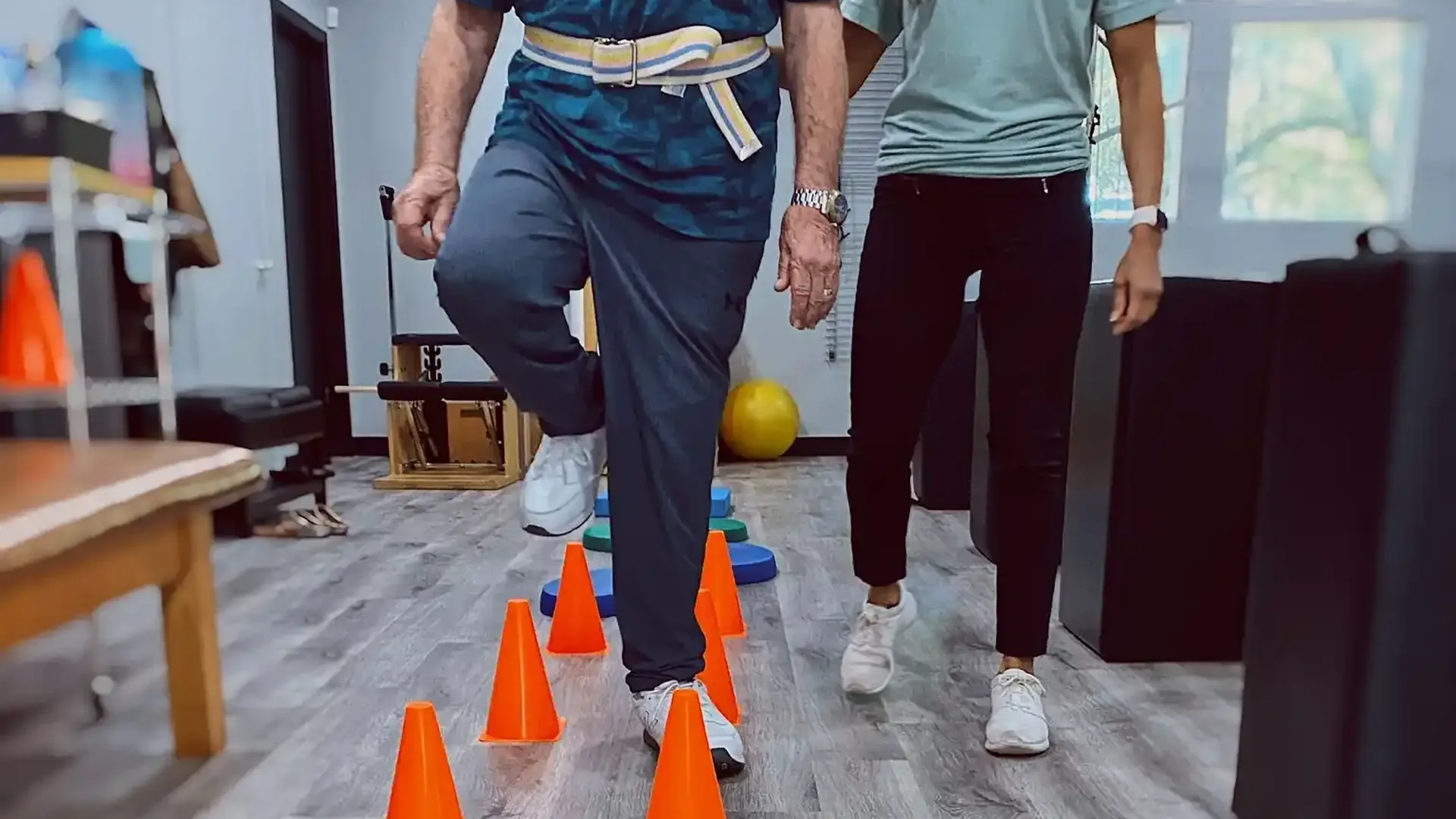
Back pain and sciatica are two different problems.
Back pain comes from the structures of the lumbar spine itself: the muscles, the discs, the small facet joints at the back of each level, and the sacroiliac joint where the spine meets the pelvis. Sciatica is nerve pain. It happens when a lumbar nerve root or the sciatic nerve is compressed or irritated, and it travels from the low back into the buttock and down the leg.
The usual causes are ordinary ones: a disc that bulges against a nerve root, facet joints that have stiffened over the years, a muscle strained during a lift, narrowing of the space the nerves pass through, or a long stretch of sitting that left the hips tight and the trunk weak. Physical therapy works on what is mechanical about all of that, restoring movement the spine has lost and building strength that keeps load off the tissue that hurts.

What back pain and sciatica actually feel like.
Where the pain sits, and whether it travels, points your therapist toward the structures involved. Some symptoms are not a physical therapy problem at all: if you develop weakness or numbness in a leg that keeps getting worse, or you lose control of your bladder or bowels, seek medical care immediately.
A Deep Low Back Ache
A dull, spread-out ache across the lower back that builds through the day and eases when you shift position.
Stiffness After Sitting
A locked-up feeling when you stand after driving or a stretch at your desk, taking a moment before you straighten up.
Pain Running Down the Leg
Sharp, burning or electric pain running from the buttock into the back of the thigh, the calf, or the foot. This is the sciatica pattern.
Muscle Spasm
The low back muscles clamping down hard and without warning, usually right after a bend, a lift, or a twist.
Numbness or Tingling
Pins and needles, or a numb patch of skin in the leg or foot, which suggests a nerve root is being irritated.
Trouble Bending or Lifting
Putting on socks, unloading groceries, or picking up a grandchild becomes something you brace yourself for first.
We watch how you move before we treat anything.
Your first visit at Pyramid Physical Therapy & Pilates starts with your story and then with movement: how you bend, hinge, rotate and load the spine, and how much of that work your hips and mid back are willing to share. Your licensed physical therapist combines what you describe with a hands-on exam to sort out which structures are producing your symptoms, and whether a nerve is involved.
Treatment from there is hands-on manual therapy to ease restricted joints and guarded muscle, then graded exercise that gives the spine something better to do. Pilates principles carry the strength work: controlled, low-load trunk and hip training on the reformer, the tower, or the mat, scaled to what you can manage today rather than what you could manage a year ago.
No referral needed to start in Texas. We are in-network with six major insurance carriers, and most patients are seen within 48 business hours or less.
In a patient's own words.
"Due to a pedestrian accident in 1990 I have worked with numerous physical therapy clinics and Pyramid Physical Therapy and Pilates is the best!"Mercy M. · Long-Term Patient
Request Your Visit
In Texas you can see a licensed physical therapist without a doctor's referral for up to 10 consecutive business days. We are in-network with Aetna, Blue Cross Blue Shield, Humana, Medicare Part B, Tricare and United Healthcare.
Tell us what your back is doing. We call back to confirm a time and check your benefits before you arrive, usually within 48 business hours.
Thank you.
Andrea will call you back to confirm a time and verify your insurance benefits. If you would rather talk it through now, call the clinic directly.