
Your hips and knees share the work of every step.
The hip and the knee are load-bearing joints in the same chain. The hip is a deep ball and socket built for power and rotation. The knee is closer to a hinge, and it depends almost entirely on the muscles above and below it to stay in line. What happens at one nearly always shows up at the other.
The sources are ordinary and treatable: cartilage that has worn with the years, tendons loaded faster than they could adapt, weak gluteal muscles that let the knee drift inward, or a stiff ankle passing extra work upward. Pain that started in one joint often traces back to a link in the chain that nobody has looked at yet.

The patterns we hear most often.
Where it hurts and what provokes it narrows the list quickly. A few things come first though: a joint that is hot, red and swollen, a knee that locks and will not straighten, or an inability to bear weight after a fall all need medical evaluation before therapy.
Pain Going Down Stairs
An ache at the front of the knee on the way down, or after a long stretch of sitting with the knee bent.
Pain on the Outside of the Knee
A sharp or burning line on the outer knee that turns up at a predictable point in a walk or a run.
A Hip That Wakes Up Stiff
A hip that feels rusted for the first stretch of the day and loosens once you have been up and moving a while.
Deep Ache in the Groin
A deep ache in the groin when you rotate the hip, get out of a car, or push into the end of your range.
The Knee Giving Way
A brief sense that the knee is about to buckle, which often comes from the quadriceps switching off rather than a loose ligament.
Trouble Getting Up
Pushing off the arms of a chair, avoiding low seats, and quietly planning your day around how many stairs are in it.
We watch you walk before we treat anything.
The clinic has an open floor for exactly this. Your therapist watches you walk, step, squat and turn, then tests hip strength, knee mechanics and ankle mobility to find where the chain is giving out. The joint that hurts is often the last link to complain, not the first one to fail.
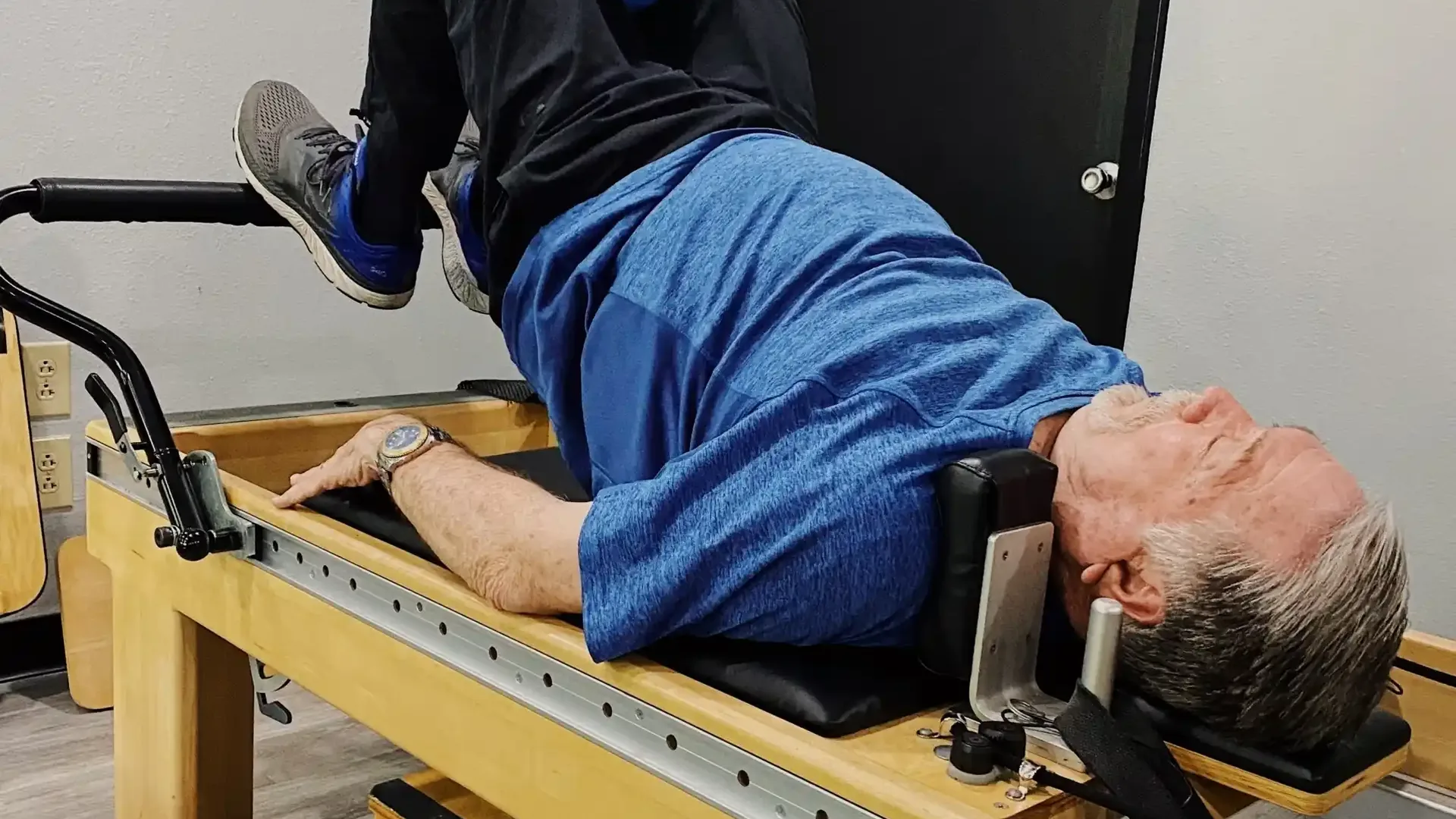
Treatment pairs hands-on joint and soft tissue work with strengthening scaled to how irritable the joint is right now. Pilates-based work fits well here: the reformer lets us load hips and knees through a controlled range at a resistance we can dial in, well before standing exercise would be comfortable. Gait retraining follows, so the strength actually shows up in how you move.
No referral needed to start in Texas. We are in-network with six major carriers, and most patients are seen within 48 business hours or less.
Request Your Visit
In Texas you can see a licensed physical therapist without a doctor's referral for up to 10 consecutive business days. We are in-network with Aetna, Blue Cross Blue Shield, Humana, Medicare Part B, Tricare and United Healthcare.
Tell us which hip or knee is the problem and what it stops you doing. We call back to confirm a time and check your benefits before you arrive, usually within 48 business hours.
Thank you.
Andrea will call you back to confirm a time and verify your insurance benefits. If you would rather talk it through now, call the clinic directly.