
A limp outlives the injury that caused it.
You hurt something, so you shifted your weight off it. That was the right call at the time. Months later the pain has gone and the shift has stayed, because walking is a habit your nervous system files away and stops checking. Gait retraining is the work of opening that file again.
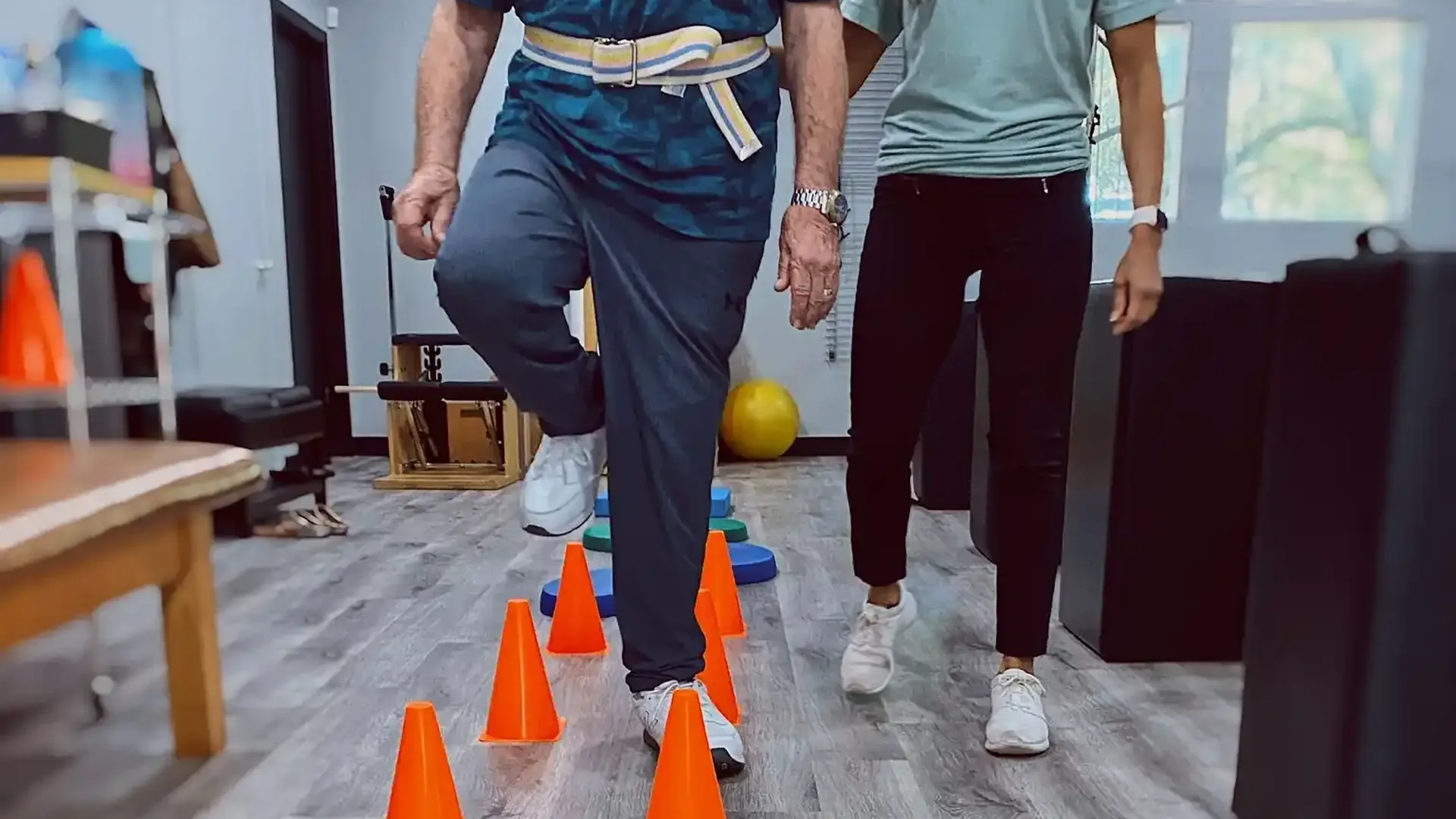
Your therapist watches you walk the open floor from the front, the side and behind, then breaks the pattern into pieces: how your weight arrives on each foot, how long you are willing to stand on one leg, how far the hip travels behind you, whether the toes clear. We rebuild whichever piece is missing, then walk it back in with cone lanes and balance discs until the new pattern is the one that runs by itself.
We take your walk apart, then put it back together.
Watching You Walk
Front, side and behind, at your own speed and then faster. Your therapist is looking for where the weight lands, how long each foot stays down, what the trunk and arms are doing, and which side is quietly doing more work than it should.
Rebuilding the Missing Piece
Whatever the walk is short of, we build it off the floor first. Reformer footwork for push off, tower springs for hip extension, side-lying work for the gluteal control that keeps your pelvis level while the other leg is in the air.
Walking It Back In
Then it goes back on the floor and gets repeated until it is automatic: cone lanes for step placement, balance discs for the surfaces that catch you out, direction changes, head turns, and walking while carrying something, because nobody walks empty-handed for long.
Let us look at how you walk.
Wear the shoes you actually walk in. Your visit is one-on-one with your therapist, and it begins with watching you move rather than with paperwork about you.
You can start without a referral in Texas. Aetna, Blue Cross Blue Shield, Humana, Medicare Part B, Tricare and United Healthcare are in-network, and we aim to have you in the clinic within 48 business hours.
Thanks, we have it.
We’ll call you back to confirm a time and check your insurance benefits. If you would rather not wait, call the clinic directly.